



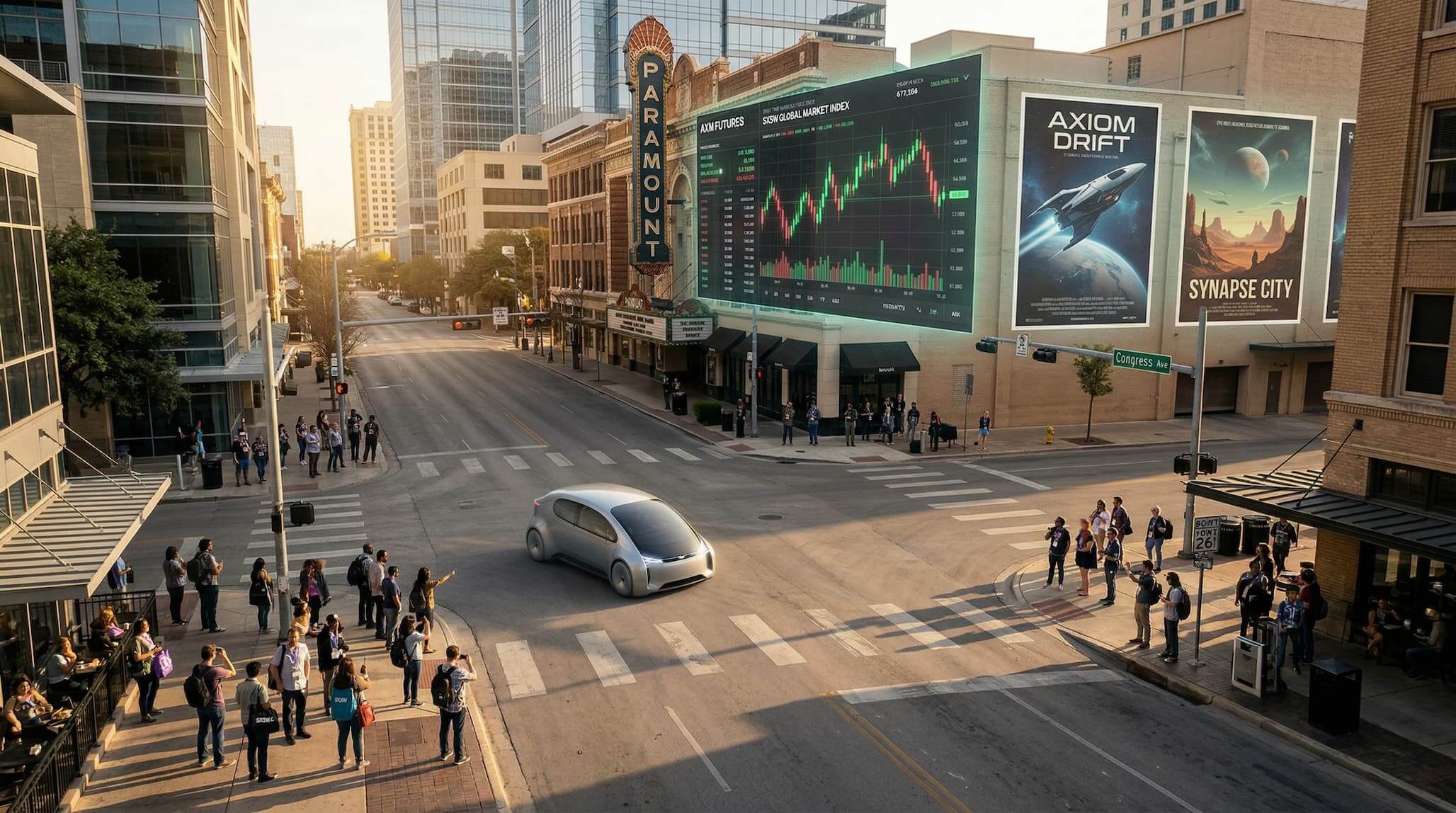
Every March, Austin becomes a preview of the future. SXSW fills the city with filmmakers, founders, technologists, and vulture capitalists—people trying to imagine what the next decade might look like. This year, one of the strangest sights downtown isn’t on a stage or in a conference hall. It’s on the streets. Self-driving cars.
Waymo robotaxis quietly navigate intersections while Tesla continues testing its autonomous driving experiment nearby. The vehicles glide through traffic cautiously, scanning their surroundings with cameras and sensors like characters in a science-fiction film.
Watching them feels oddly cinematic. Which is fitting, because SXSW has always lived at the intersection of technology and storytelling. And that intersection turns out to be important for understanding something else entirely: financial markets.
Markets Run on Narratives
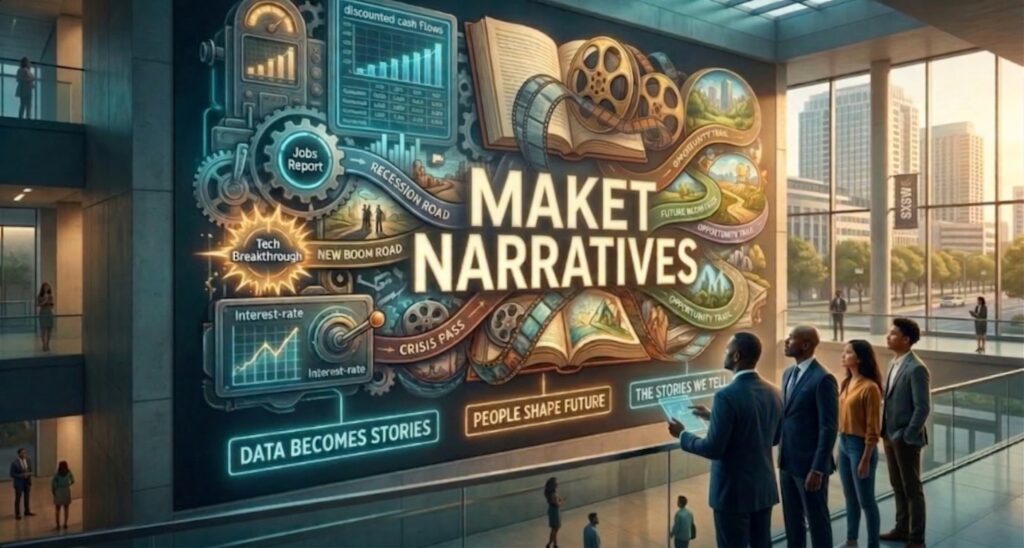
Investors often talk about markets as if they were purely analytical machines. Models. Interest rates. Discounted cash flows. But markets behave much more like storytellers. Every economic data point gets wrapped in a narrative about what it means for the future.
A jobs report becomes a recession signal. A technology breakthrough becomes the start of a new boom. An interest-rate change becomes the beginning of a crisis. The data rarely speaks for itself. People tell stories about it.
The First Televised War
For many Americans, the first Gulf War in 1990 was the moment geopolitics became a media spectacle. CNN had just emerged as a 24-hour news network. Suddenly the world was watching grainy night-vision footage of missiles striking Baghdad while up-all-night anchors tried to explain what was happening in real-time. War looked like a sci-fi movie.
Years later, the documentary The Fog of War explored how uncertain those decisions were behind the scenes. Leaders were operating with incomplete information, conflicting intelligence, and enormous pressure.
Markets face a similar challenge. Investors are constantly trying to price the future while the story itself is still unfolding.
Oil, Power, and the Real Economy
When geopolitical tensions rise, markets almost always turn their attention to oil. Energy prices sit at the intersection of politics and economics. Supply disruptions, sanctions, and military conflict can ripple quickly through global markets. But something else has changed over the past few decades.
The global economy has become dramatically more resilient. Technology has made industries more energy efficient. Supply chains adjust faster. Businesses innovate around constraints.
During the oil shocks of the 1970s, energy prices could stall entire economies. Today the system is more diversified, more technologically advanced, and far more adaptable. Which means the real economy often keeps moving forward — even when the headlines suggest otherwise.
The In-Depth Documentary
In the short run, markets feel dramatic. Headlines arrive like plot twists. Prices swing. Narratives change by the hour. But over longer stretches, markets behave less like Hollywood thrillers and more like long-form documentaries. Slow. Incremental. Millions of small decisions, unfolding across decades.
Innovation continues. Businesses build new products. People keep working, saving, and investing. In other words: Less Michael Bay. More Ken Burns. And historically, those documentaries tend to have pretty good endings.